

What Is Digital Diagnostic Monitoring (DDM)?
Today we will be discussing SFPs and the function of Digital Diagnostic Monitoring, or DDM for short. DDM was already briefly mentioned in the article on SFPs. Today, I would like to explain it in more detail. DDM plays an important role in the use of fiber optic cables. DDM greatly simplifies troubleshooting and diagnosis in the event of faulty fiber optic connections. However, this requires that both the network device (switch, media converter) and the SFP plugged into it support the DDM function.
SFP Transceivers and Their Role in Fiber Optic Networks
As a reminder, the abbreviation SFP stands for Small Form-factor Pluggable. SFPs are the most widely used type of optical transceiver and are also commonly referred to as mini-GBICs. As small, standardized modules for network connections, they are inserted into designated slots in media converters and switches and are used to convert fiber optic signals.
Functionality and Standardization According to SFF-8472
In order to verify the functionality of such an optical network, which can extend over a distance of more than a hundred kilometers, it is crucial to keep constantly updated on the status of the optical transceiver and the optical cable. Digital Diagnostic Monitoring was developed for this purpose, and its functionality is defined in the Multi-Source Agreement (MSA) SFF-8472.
DDM allows the status of the optical transceiver to be monitored in real time. Various parameters of the optical transceiver, such as temperature, supply voltage, or transmit and receive power, can be analyzed without having to switch off or configure the device.
DDM in Practice: Reading Transceiver Data
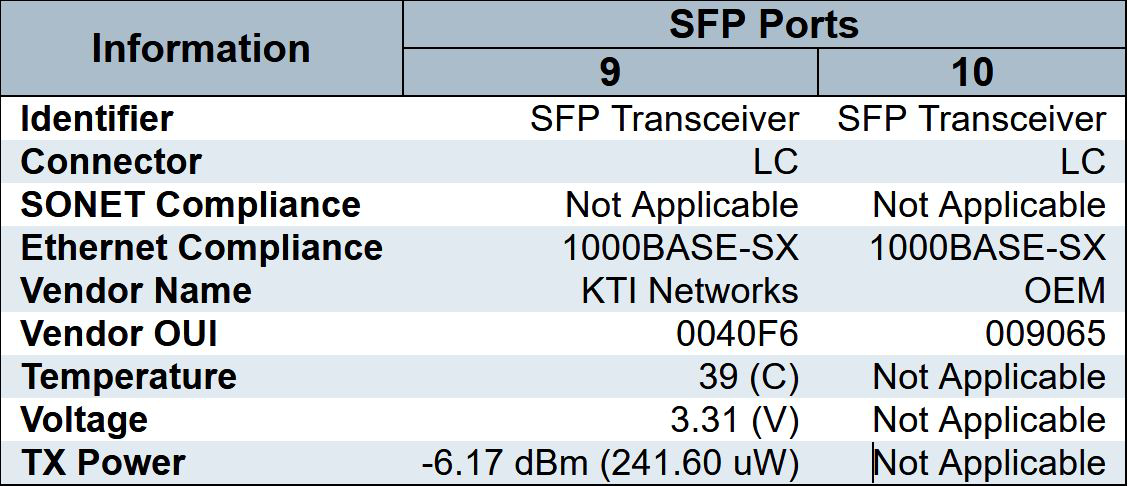
View of the management function of the KTI KGS-1060 industrial switch: An SFP that is DDM-capable is plugged into port 9. The bottom three positions show the temperature, operating voltage, and transmission power. The SFP plugged into port 10 does not support DDM.
Proactive Monitoring and Alarm Functions with DDM
In addition, DDM can be used to program alarms and warnings that notify the host device if a transceiver is not functioning properly or if certain thresholds are exceeded or not reached. The values can also be transmitted via SNMP (Simple Network Management Protocol).
DDM enables users to maintain the network proactively and predictively. This allows network managers to identify potential faults before they affect the network, e.g., if the transmission or reception performance is continuously deteriorating. Ultimately, DDM also serves to check the compatibility of the SFP module used.