

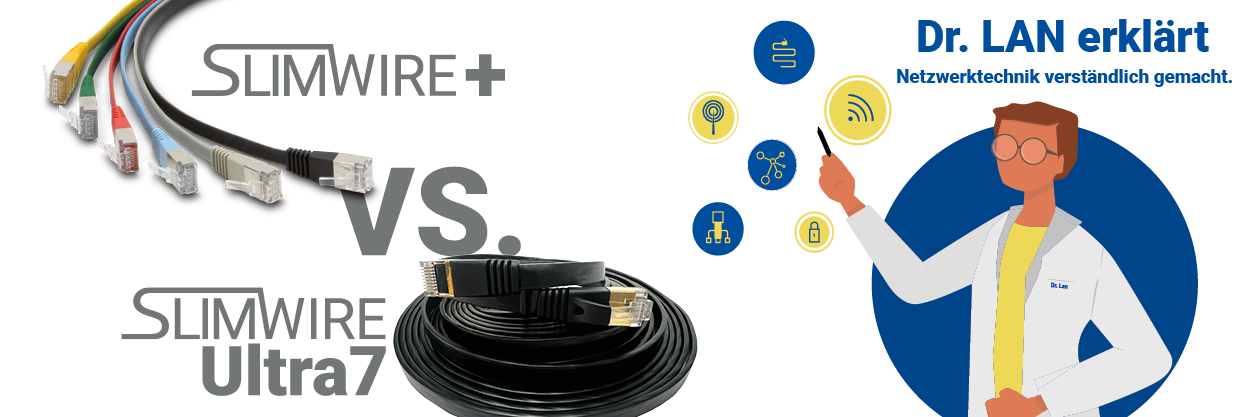
Dr. Lan explains: SlimWire+ vs. SlimWire Ultra 7
Which patch cable really fits your application?
Is unshielded sufficient, or is additional protection required?
In this edition of „Dr. Lan explains“ we take a closer look at two variants: SlimWire+ and SlimWire Ultra 7. What are the differences, what exactly do UTP and U/FTP mean, and when does which solution make sense?
Focus on network technology: SlimWire+ vs SlimWire Ultra 7
In modern networks, choosing the right patch cables is crucial, not only for performance, but also for ease of installation and interference resistance. SlimWire cables are characterized by their extremely flat, flexible design—ideal for tight spaces such as under baseboards, carpets, or in densely packed server cabinets.
SlimWire+ - Unshielded for standard network applications
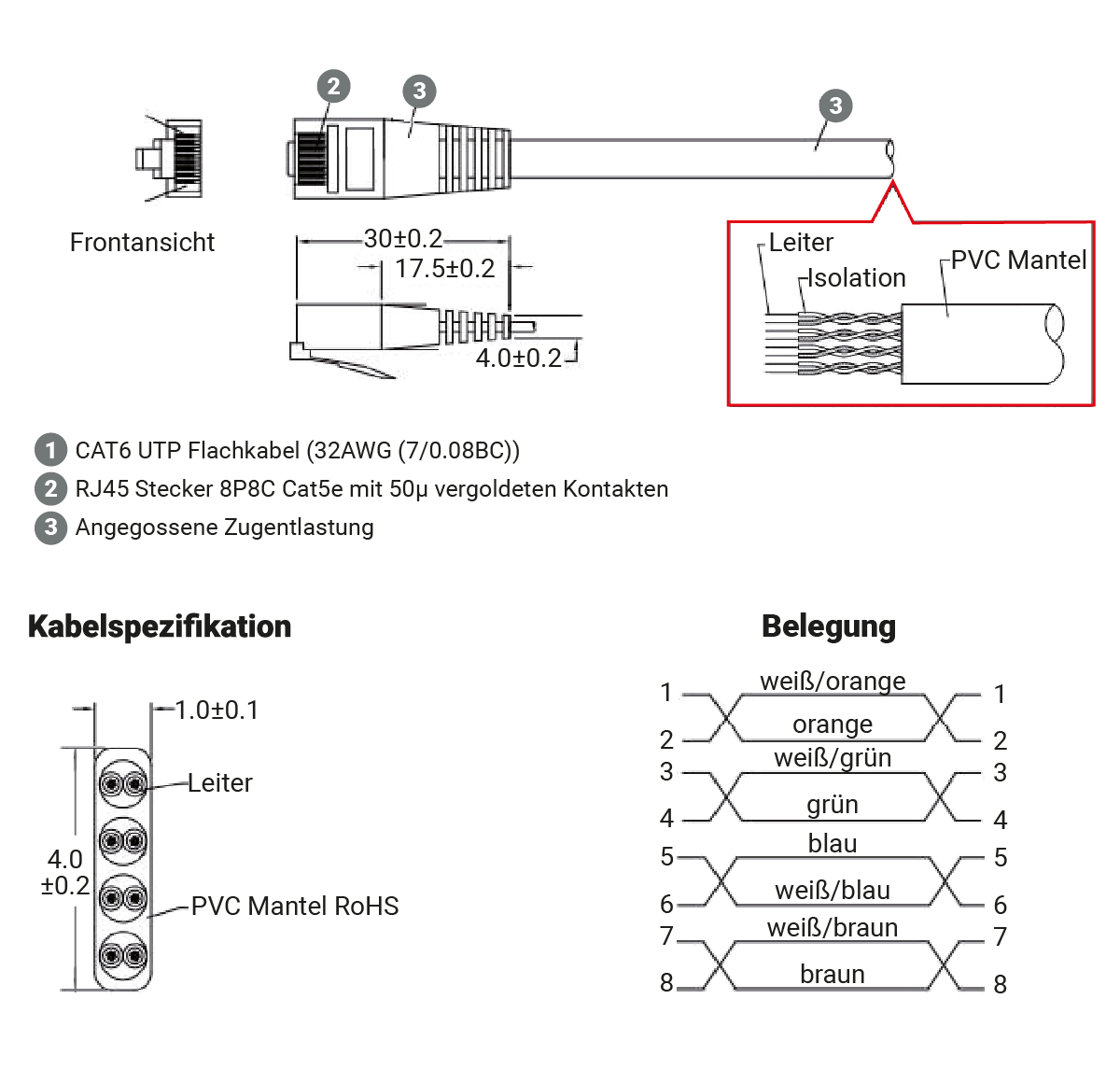
The standard SlimWire patch cable—available in lengths ranging from 0.15 to 15 meters and seven different colors—is easy to install and simple to identify in cluttered patch panels.
SlimWire+ is a UTP (Unshielded Twisted Pair) cable, meaning it is unshielded. It complies with the CAT6 standard, is Gigabit-capable, and supports PoE applications. Its ultra-flat design makes it particularly suitable for applications where flexibility and low height are required.
Important: “UTP” means that there is no additional shield, only twisted pairs of wires that ensure signal integrity through mutual coupling suppression.
SlimWire Ultra 7 - High Performance with Shielding
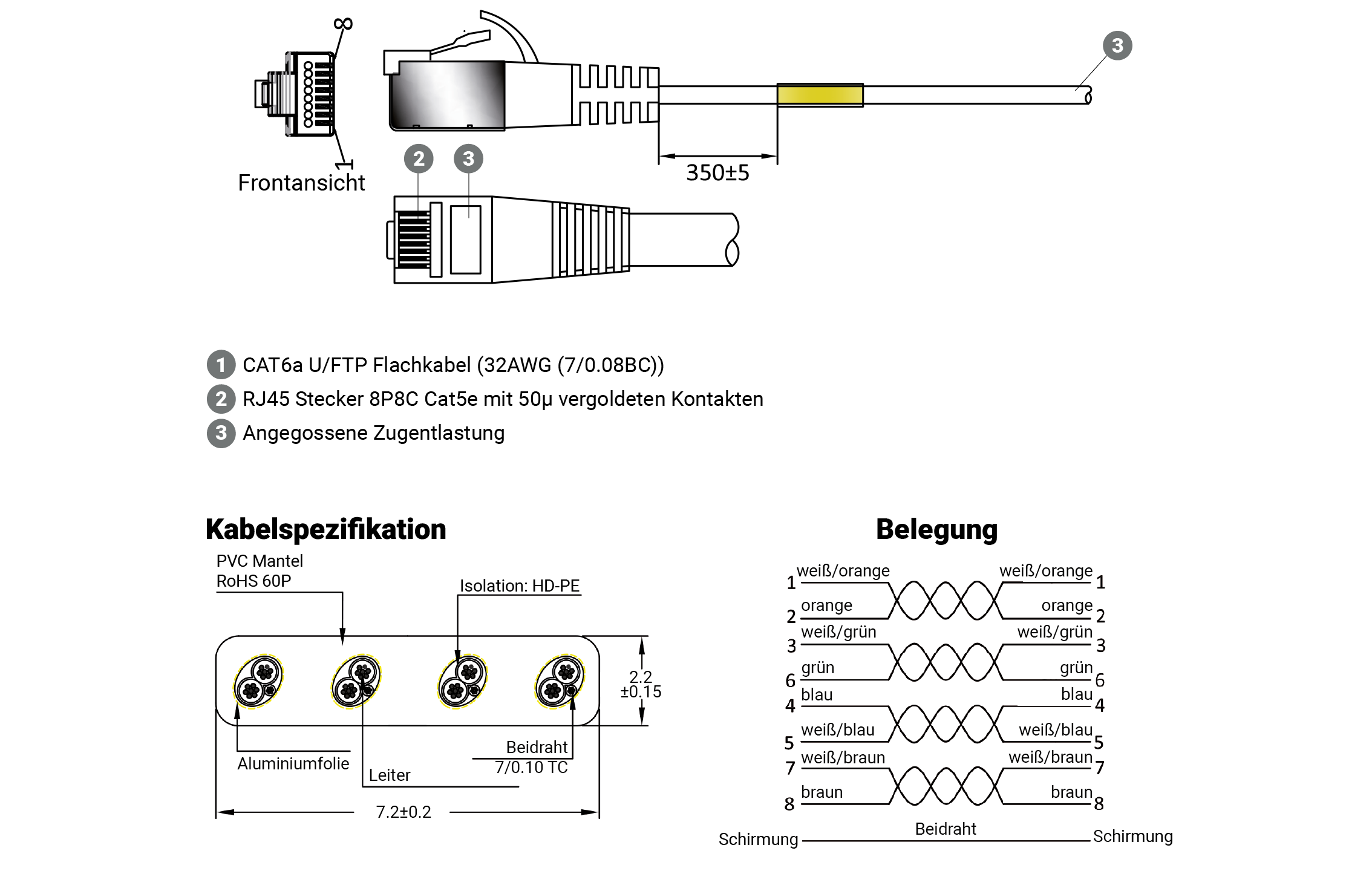
The SlimWire Ultra 7 builds on the idea of the ultra-flat SlimWire patch cable, but adds shielding. It is a CAT7 STP cable (Shielded Twisted Pair / U/FTP) and therefore more powerful than typical CAT6 UTP patch cables. It supports transmission frequencies up to 600 MHz, 10 Gigabit Ethernet, and PoE up to 90W, and comes with high-quality gold-plated contacts.
Shielding is particularly useful in areas where electromagnetic interference (EMI) can occur, e.g., in server rooms, industrial environments, or densely populated cable trays.
Digression: Overview of shielding types
Patch cables differ not only in category and speed, but above all in their shielding, which reduces electromagnetic interference.
| Shielding Type | Designation | What is protected? |
|---|---|---|
| UTP | Unshielded Twisted Pair | No shielding |
| FTP / F/UTP | Overall foil shield | Entire cable against interference |
| STP / U/FTP | Pairwise foil or wire shielding | Each pair individually shielded |
| S-STP / SF/FTP | Overall and pair shielding | Maximum protection against EMI |
What does this mean in practice?
UTP (unshielded) is well suited for normal network environments without strong sources of interference (typical office use, WLAN areas, home networks).
STP (shielded) reduces additional interference from other cables or electrical devices, which is particularly helpful at high data rates or in EMI-rich environments.
UTP vs STP, bzw. U/FTP: Advantages and Disadvantages
Unshielded Cables (UTP)
Advantages:
- Cheaper, easier to install
- More flexible and easier to route
- No grounding required
Disadvantages:
- Less protection against external electromagnetic interference
Shielded Cables (e.g., STP / U/FTP)
Advantages:
- Better protection against interference
- Ideal for environments with many parallel cables or where other electrical systems cause interference
Disadvantages:
- More expensive, more complex to install (grounding required)
- Grounding and correct installation are important, otherwise the shielding itself can cause problems
Perfect for demanding applications such as medical facilities, industrial plants, server cabinets, etc.
Important: Shielded cables only benefit if the network components (patch panels, jacks) are also designed accordingly and properly grounded.
Conclusion: SlimWire+ or SlimWire Ultra 7?
| Application | Recommendation |
|---|---|
| Standard LAN cabling | **SlimWire+** - slim, flexible, and economical |
| High performance & EMI-critical | **SlimWire Ultra 7** - shielded, robust, and future-proof |
| Tight installation spaces | **Both** - due to the ultra-flat design, both SlimWire+ and Ultra 7 are particularly suitable |
If you want to wire your network quickly, clearly, and flexibly, SlimWire is an excellent solution. Use SlimWire+ for all standard applications. Choose the shielded SlimWire Ultra7 if you want to use it in an interference-prone environment or want maximum data integrity.